
How to Search St. Charles Parish Criminal Dockets
For any district court criminal matter in St. Charles Parish, go first to the St. Charles Parish Clerk Public Records Search. The site sits behind an AWS web challenge. Plan on patience with its filters, field labels, image access, and fees. A case number is the strongest search key. If you must search by name, write down the division, filing date, charge count, and case status from any matching record. Then ask the Clerk to confirm it.
The eClerks LA Statewide Portal and LCRAA offer account-based routes to participating clerk records. Neither is a complete criminal docket system for the parish. A blank online search is never the last word. When a record is old, an image is missing, the division is unclear, or you need a certified copy, call the Clerk, visit the counter, or mail a precise request.
- Read the charging notice, court paper, or prior minute entry for the case number, division, and date.
- Search the local Clerk route by case number first, or by the exact defendant name if the live form offers that option.
- Confirm that the case is assigned to the correct 29th JDC division and review the newest event rather than an old setting.
- Ask the Clerk whether a charge, minute, plea, order, or judgment is available as an image, plain copy, certified copy, or minute extract.
- Use division staff for a current setting question and the Sheriff only for post-court bonds or fines, not for the docket itself.
St. Charles Parish Criminal Charge Entries
Reading the entry itself matters more than the tool you use. In a live criminal case, check the header first. Look for case number, court, division, filing date, judge, status, and case type. Then find the charge block. It should list the offense title and the Louisiana statute. It should also show the degree or classification, the count number, and any amended charge.
The vocabulary deserves care too. An indictment comes from a grand jury. A bill of information is filed by a prosecutor. An arraignment records how the charge and plea were handled. A minute entry is the clerk's short official record of what happened in court. The newest signed minute or order usually gives the best statement of the current setting.
- Charge count
- A separate alleged offense within the same case.
- Arraignment
- A court event where the charge is presented and a plea is entered or recorded.
- Minute entry
- The court’s concise official record of the proceeding or ruling.
- Disposition
- The recorded result, such as dismissal, conviction, acquittal, or another closing action.
What a St. Charles Parish Criminal Docket Shows
A St. Charles Parish criminal docket is the event history of one court case. It is not an arrest list. It is not a full investigation file either. It can show the parties, filings, settings, orders, pleas, trials, sentences, and any appellate activity. A live case may also carry bond details, costs, restitution, and payment balances. Read each field in time order. A filed motion has not necessarily been granted. A setting is not a final disposition.
St. Charles Parish publishes no uniform criminal case-number format. Do not build a pattern like 2026-CR-00001 on your own. Use the exact number printed on the notice or given by the Clerk. When a division letter appears in a record, C, D, or E, it is a locally meaningful way to tell district court assignments apart.
| Header | Case number, 29th JDC division, filing date, judge, status, and case type to confirm in the live file. |
|---|---|
| Charge block | Offense, statute, classification, count, and any amended charge. |
| Parties and counsel | The State, accused person, prosecutor, defense counsel, and appointed counsel if shown. |
| Settings | Date, time, division, event type, and whether a later entry resets or vacates an earlier date. |
| Outcome | Plea, dismissal, conviction, acquittal, sentencing, probation, or appeal information. |
St. Charles Parish Criminal Duty Judge
Local rules give the duty judge a defined role early in a case. The 29th JDC duty judge handles weekend and holiday emergencies. The judge also handles bail, indigent counsel, and search or arrest warrants. Justices of the peace serve parishwide as committing magistrates. They take criminal matters that are not capital and not necessarily punishable at hard labor. These functions can generate early court events. But the Clerk still keeps the district court criminal record.
Money adds a second step. The Sheriff's Bonds and Fines office collects fines ordered by district judges. It processes related payments after court action. It publishes no general criminal docket. A payment status cannot establish the charge history, the current setting, or the final outcome. Identify the court event in the case record first. Then use the Sheriff's route only for the financial piece that applies.
The 29th JDC Division C page lays out the court's public division and staff structure.
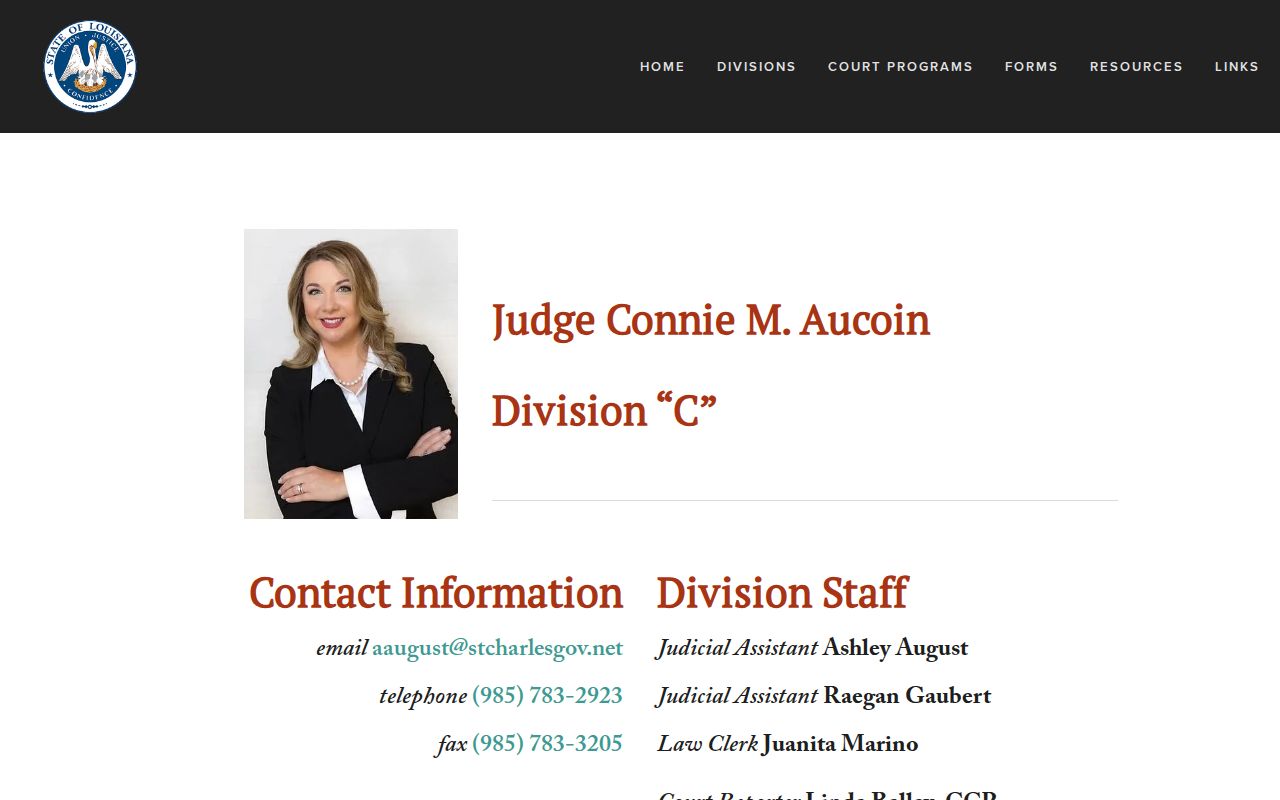
Division staff pages are a setting-confirmation fallback, not a substitute for the clerk-held criminal docket.
Stages on St. Charles Parish Criminal Dockets
Most criminal dockets open with an arrest or complaint. A bill of information or an indictment can also start the case. Early entries often cover bail, warrants, counsel, an initial hearing, and arraignment. Later entries may show pleas, pretrial matters, motions, notices, continuances, trial settings, sentencing, fines, restitution, probation, and an appeal. Under the local appendix, grand jury terms are scheduled in the first weeks of April and October. Matters rotate among divisions.
Treat each step as a recorded event, not a prediction. A notice of trial can be followed by a reset. A plea can be followed by sentencing, and a judgment by an appeal. Whatever the stage, the signed minute, order, or judgment controls over a shorthand note or an earlier calendar date.
Docket flow: Charge filed › Arraignment › Pretrial settings › Plea or trial › Disposition › Sentencing or appeal
St. Charles Parish Related Felony Dockets
Felonies that grow out of the same events tend to stay together in St. Charles Parish. Local rules keep related cases before a single division. Homicides and drug roundup cases, though, rotate among the judges. So one division can carry several charges and filings from one matter. Before assuming two similar hits are unrelated, match the case number and the division in your docket search.
Traffic tickets and misdemeanors without an arrest take another route entirely. An annual allotment schedule in the Clerk's Office assigns them. That is why a citation may land somewhere unexpected. Let the paper guide you: check the citation, the current docket event, and the court named on it. The Division D page gives an official contact route for that 29th JDC division.
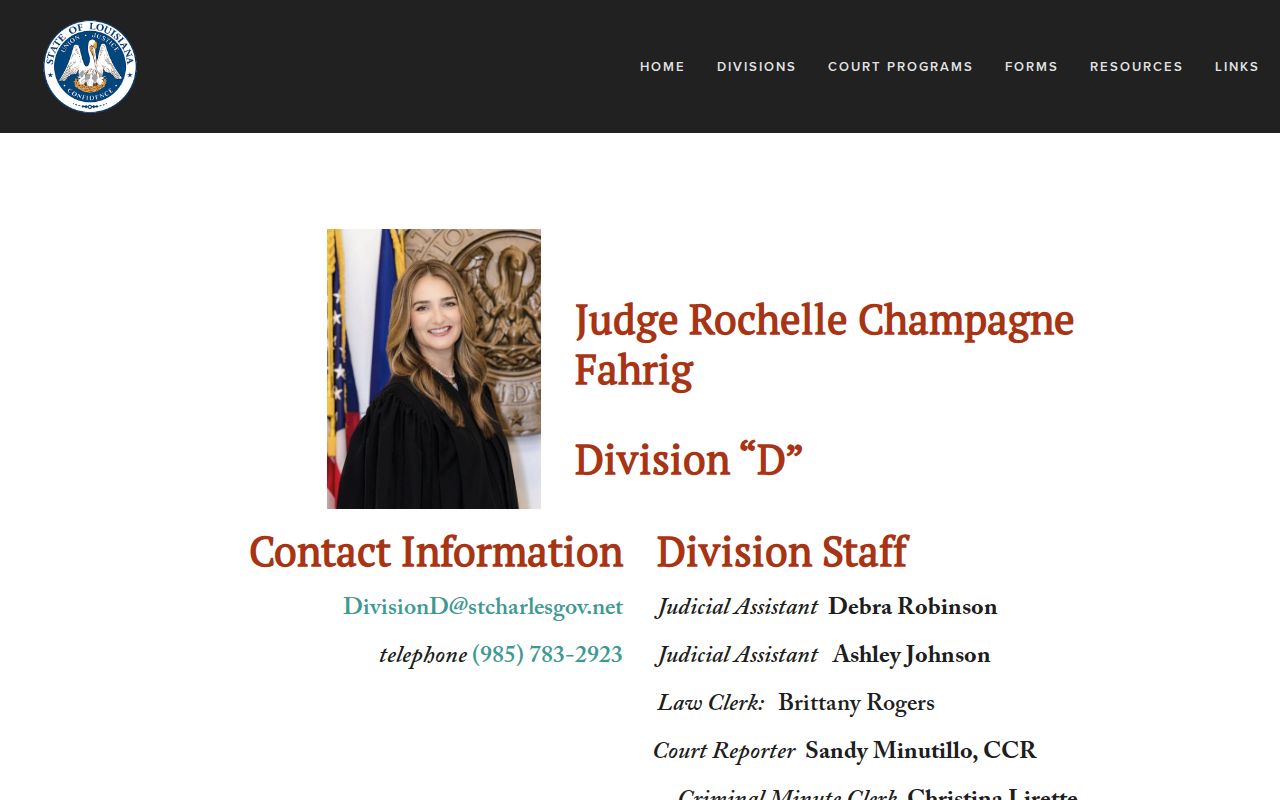
Once you confirm the case number and division, the division page helps you find staff for a specific setting.
Which St. Charles Parish Court Holds Criminal Dockets
Criminal dockets in St. Charles Parish live in the Twenty-Ninth Judicial District Court. The St. Charles Parish Clerk of Court keeps the records. Three general divisions hear these cases: C, D, and E. A justice of the peace can act as a committing magistrate, but that role does not make the JP office keeper of the later 29th JDC criminal file. Appeals from the district court go to the Louisiana Fifth Circuit Court of Appeal. That court may hold an appellate record apart from the original lower-court file. The Fifth Circuit eCourt page offers the appellate search layer. Keep the appellate case number and court name handy, because an appeals docket is separate from the trial-court docket. Federal criminal cases belong to a different court system. They should stay off this Louisiana state route.
St. Charles Parish Drug Court Dockets
The St. Charles Adult Drug Court has operated since 2000. It takes eligible nonviolent probationers into a specialty track. That track is tied to an underlying court case, not a standalone public criminal search database. Four phases make up the program. First comes stabilization, then cognitive restructuring and relapse prevention, then continuing care, and finally a transition back to daily life. Judge Lauren Davey Rogers presides.
What shows up on a docket? Possibly a referral, a review, a treatment status, graduation, or a probation event. The exact labels vary, so treat a thin entry with care. A blank docket does not prove nonparticipation. For the court file itself, go through the Clerk. Confidential or restricted details stay sealed under the governing statute or order.
The presiding judge's division has its own page. The 29th JDC Division E page covers it, and lists the public staff information.
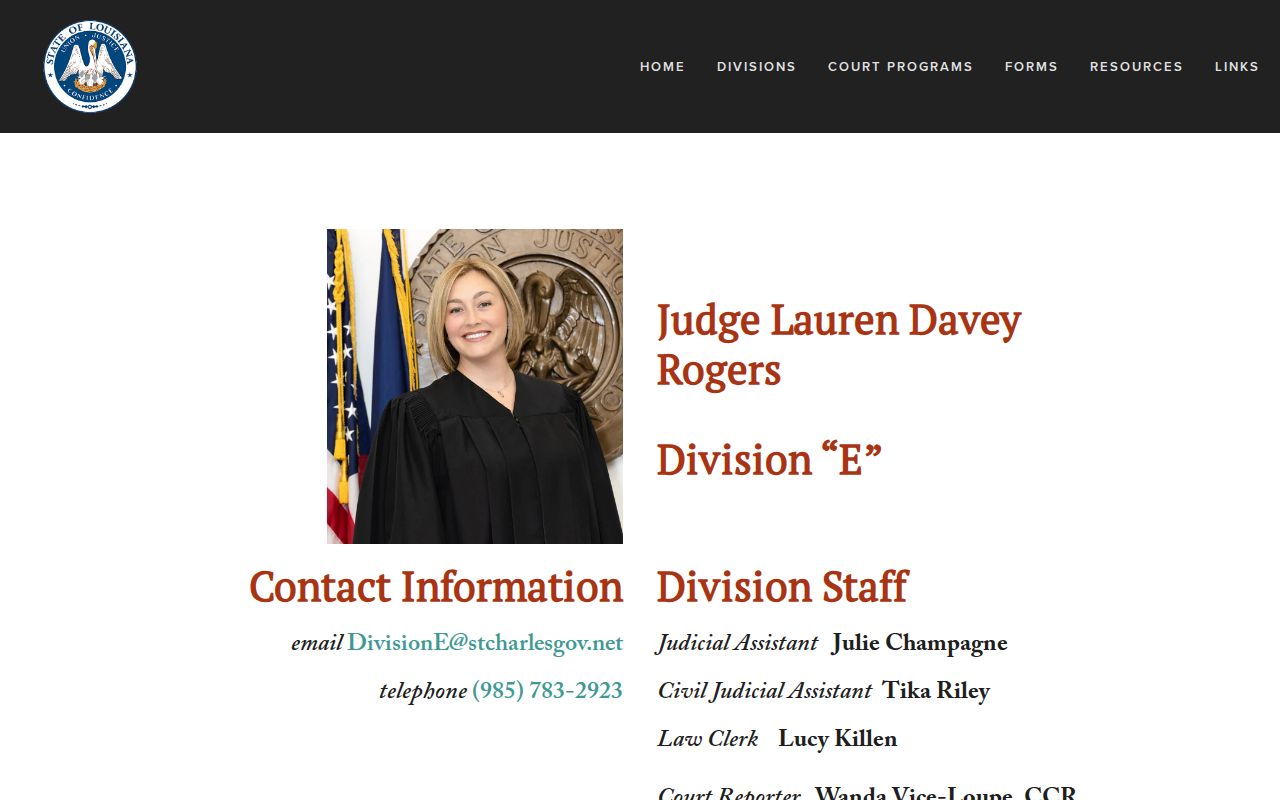
Division E's public page gives the court contact context for the judge who presides over the program. Use it once you have confirmed the underlying case.
Public Access and Sealed Criminal Dockets
Access to a St. Charles Parish criminal docket runs through the clerk-custodian rule and Louisiana public-records law. Restrictions layer on top. A case can carry a full public event history. Meanwhile, images, protected personal details, juvenile records, or sealed documents stay unavailable. Dismissal does not seal a charge on its own. A blank result can also mean the record is restricted. It may be held elsewhere, or simply not online. Ask the Clerk what drives a particular limit. It could be juvenile confidentiality, a sealing order, a protective measure, or another law. Sheriff's rules on investigative reports are a separate matter. They say nothing about whether the 29th JDC docket itself is closed.
Key rules:
La. C.C.P. art. 251 identifies the clerk as custodian and provides for lawful examination and copies.
La. R.S. 44:31 recognizes public-record inspection and copying unless an exception applies.
La. Ch.C. art. 412 protects juvenile proceeding records except for stated access.
Rule V, Section 5 addresses the handling of documents filed with a motion to seal.
St. Charles Parish Criminal Docket Copies
When the online index falls short, ask the Clerk for the exact product you need. La. R.S. 13:847 sets the statutory amounts. Criminal copies run $1 per page, $3 for a conformed copy, $5 for certification, $20 for a criminal-history search, and $10 for an extract of court minutes. The clerk may charge less. Postage runs at actual cost. Confirm the current total before you mail payment. A good request names the case number, the defendant or caption, the division, and the document title or date. Say whether you want a plain, certified, or conformed copy or a minute extract. Once the office confirms the details, mail can go to the Clerk at P.O. Box 424, Hahnville, LA 70057. No verified electronic-image fee, payment method, or turnaround time is published. The 29th JDC FINS page underscores one point. Juvenile diversion information is not a public individual criminal docket.
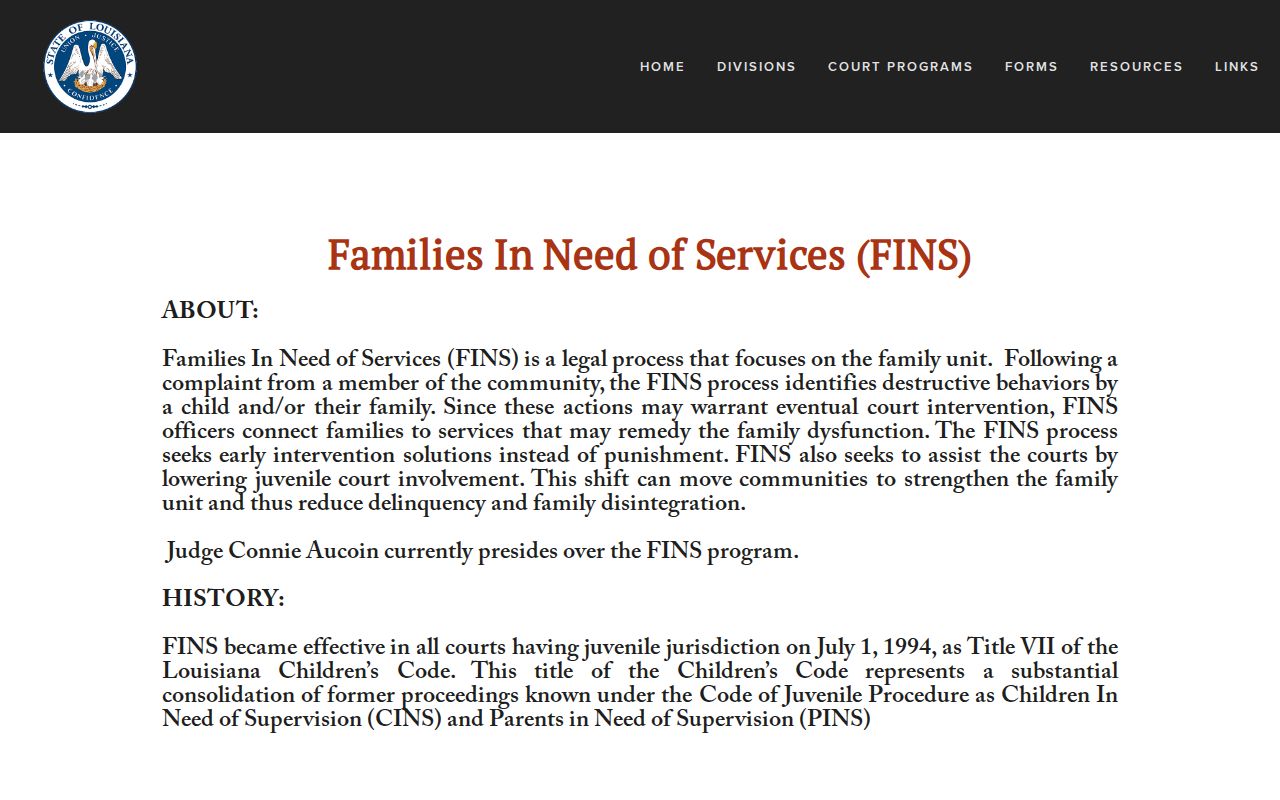
FINS material supports the confidentiality distinction, not a public route for juvenile records.
Note: The criminal-history search fee is a clerk fee category, not an online people-search or screening product.