
How to Search the St. Charles Parish Court Docket
Start with the St. Charles Parish Clerk Public Records Search for any 29th JDC matter. It is the right first stop. The live page sits behind a web-access challenge, though, so call the Clerk to confirm its search fields, image coverage, fees, and update schedule. Use the case number if you have it. If not, begin with an exact party name, then keep the filing date, case type, and division from any matching result.
Louisiana posts no single public statewide trial-court docket. The eClerks LA Statewide Portal is an account-based route into participating clerk record sets, including the civil information described by LCRAA. A JP civil, eviction, small-claim, or committing-magistrate matter belongs with the relevant JP office. Each office keeps its own records. An appeal also has a separate Fifth Circuit record. Online paths stall sometimes. The clerk's counter, phone line, and a targeted mail request still round out a complete St. Charles Parish docket search.
- Read the notice, citation, petition, or prior minute entry for the case number, court name, division, and date.
- Try the Clerk Public Records Search for a 29th JDC case, using the exact case number or party spelling if the live form offers those choices.
- Use an eClerks account only for a participating record type, and do not assume that account access supplies every criminal record or document image.
- Check the newest event, minute entry, or signed order for the current setting and any reset, rather than relying on an old date.
- Call, visit, or mail the Clerk when a result lacks an image, a record is older, or a certified copy is needed.
St. Charles Parish Clerk Portal Limits
A public search result and a full court file are different products. The clerk's local page is titled Public Records Search. Read results with care. It does not spell out which case fields, years, images, or prices it carries. Ask the office directly. A result may name a case or document type without supplying the image. That gap matters most for older files. Sealed materials and juvenile matters are affected too. So are entries that need a separate account or copy request.
The Clerk of Court homepage is the official starting point for the local records route. That question changes the price. Ask whether a result is an index entry, a document image, a plain copy, or a certified copy. One call can settle that. Ask whether the Clerk or one of the seven JP offices holds the original record.
The Clerk of Court's official homepage identifies the local records source for this St. Charles Parish court docket route.
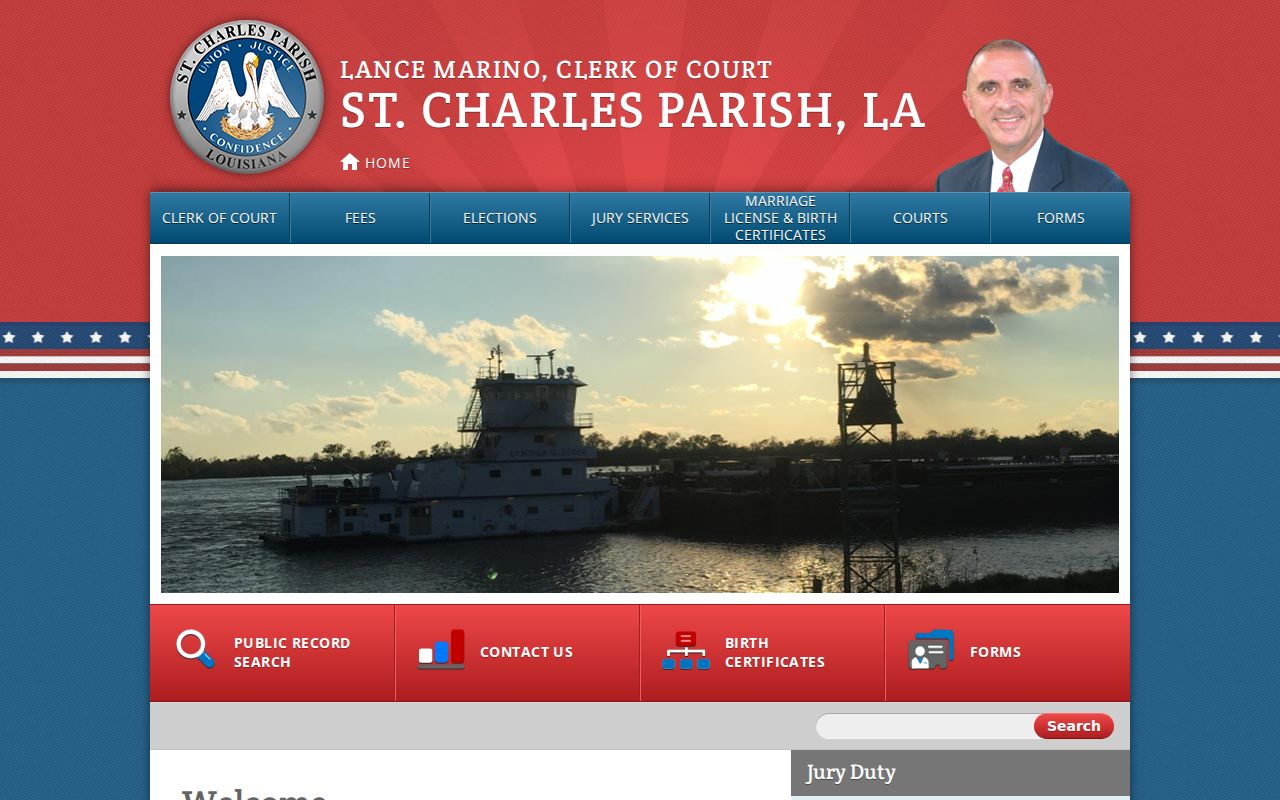
The clerk route works well for finding records. The office itself must confirm whether a requested copy is available and in what form it will be issued.
What a St. Charles Parish Court Docket Shows
A docket tracks a case in order, entry by entry. A live 29th JDC record may list the caption, case number, division, filing date, judge, case type, parties, counsel, events, settings, orders, and final disposition. Exact labels vary by screen. Treat these as fields to look for rather than a map of any particular page. And a docket is not the whole case file. Pleadings, exhibits, minutes, and certified documents live beyond it.
The newest signed minute or order is often the most useful entry. It may replace a prior setting, record a plea or judgment, or show that a case has moved to an appellate docket. Older entries tell you where the case has been. Keep the division letter when it appears. The 29th JDC has Divisions C, D, and E. That assignment helps the clerk or division staff pull the right file fast.
| Case number | The clerk-assigned identifier used to distinguish the matter. No uniform local civil or criminal number format was verified. |
|---|---|
| Caption and parties | The formal title and party roles, such as plaintiff and defendant or the State and an accused person. |
| Division and judge | A 29th JDC assignment, commonly Division C, D, or E when published. |
| Events and filings | Entries for pleadings, notices, motions, orders, minutes, hearings, and continuances. |
| Settings | The date, time, court or division, and event type. A later signed entry may supersede an earlier date. |
| Disposition | The recorded outcome, such as judgment, dismissal, conviction, acquittal, or an appeal entry. |
St. Charles Parish Three-Division Docket
The Twenty-Ninth Judicial District Court for the Parish of St. Charles is the parish's general-jurisdiction trial court. Its three elected divisions are C, D, and E. They hold original civil, criminal, and juvenile jurisdiction. That structure shapes the docket. The St. Charles Parish Clerk of Court keeps the district-court record. Each judge page lists staff such as minute clerks, court reporters, assistants, and bailiffs. That matters when you call about a setting.
Division assignment is more than a label. Civil cases are publicly allotted by a random, mechanical, or electronic process. Criminal allotment follows local rules. A related felony may stay in the same division. For a current hearing, the record names the division, and division contacts beat a stale generic calendar listing. Calling the right courtroom saves a step.
The 29th JDC homepage identifies the court that maintains this three-division St. Charles Parish docket structure.
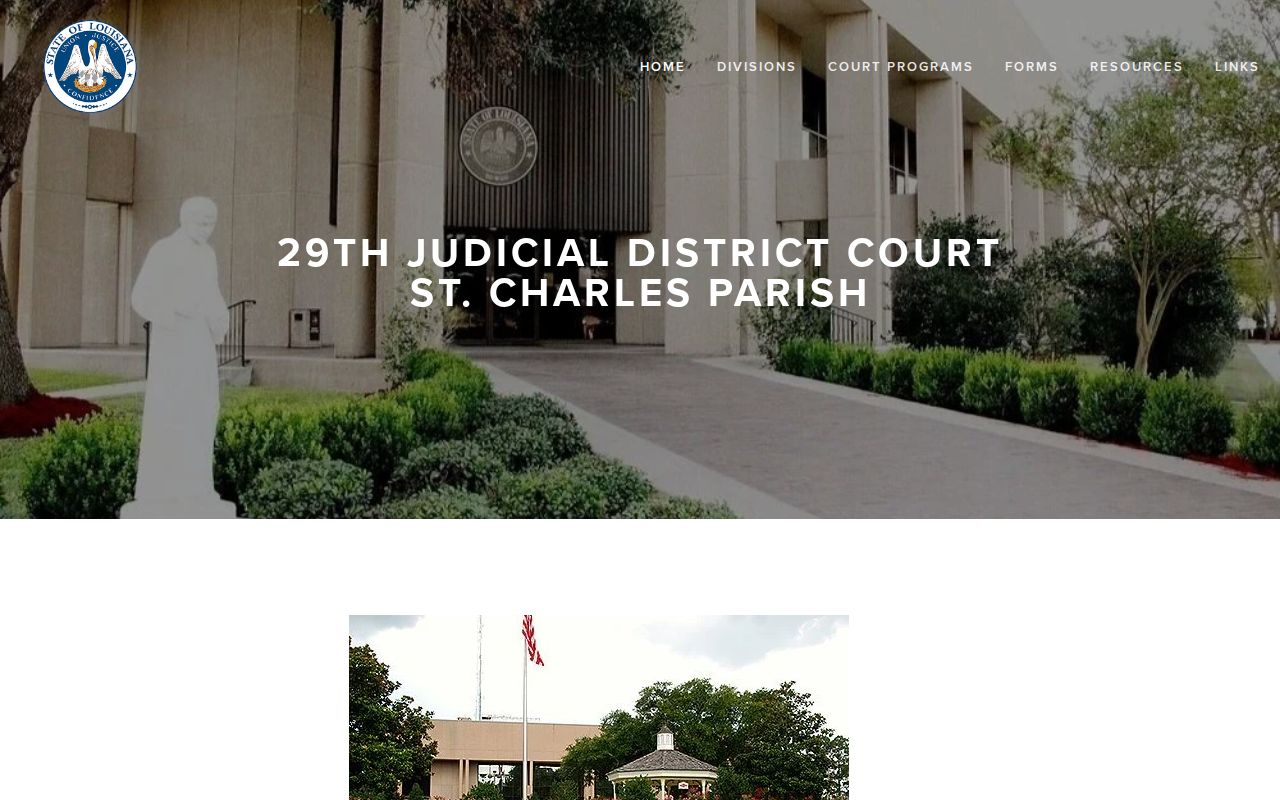
The court homepage helps you identify the court and its divisions. The clerk still holds the legal records and handles copies.
Which St. Charles Parish Courts Keep Dockets
Start with the court that received the case. The 29th JDC and its Clerk handle general civil and criminal matters, family and juvenile matters, probate and succession records, and appeals from local JP courts. Seven JPs keep separate lower-court records. Their dockets cover limited civil disputes, evictions, possession of movable property, and some committing-magistrate functions. Sheriff Bonds and Fines is a payment office. It is not a general civil or criminal docket custodian.
St. Charles Parish has no incorporated municipal courts. Luling, Destrehan, St. Rose, Boutte, and Norco are community profiles, not separate city courts. Route a traffic citation to the court named on the citation. Use the Sheriff's payment channel only after you understand the court's disposition. The citation itself tells you where the case lives.
| Court or office | Docket covers | Where to search |
|---|---|---|
| 29th JDC, Divisions C, D, E | General civil, criminal, family, juvenile, probate, and JP appeals | Clerk Public Records Search, clerk counter or phone, division staff for settings |
| St. Charles JP districts | Limited civil matters, evictions, movable-property claims, and local magistrate functions | The responsible JP office named by district |
| Sheriff Bonds and Fines | Traffic and criminal fine or bond payment records after court action | nCourt, Bonds and Fines counter, mail, or the fine voice line |
| Louisiana Fifth Circuit | Appeals from the 29th JDC | Fifth Circuit eCourt and eAccess |
St. Charles Parish LCRAA Is Not One Docket
LCRAA and eClerks give account holders secure remote access to records from participating clerks. That makes the statewide service useful for St. Charles Parish land, marriage, and civil material. Those record sets appear in LCRAA's own descriptions. It is not one public statewide trial-court register. Visitors without an account get routed to a sign-in screen. Criminal coverage and full document images for this parish are not assured.
The gap trips up many searchers. An empty eClerks result can mean an account wall, a missing participating record, a JP file, an older record, or a restriction. It can also mean a paper record only the Clerk can produce. So the local Clerk portal, the clerk counter, and a direct call still matter.
The local Clerk Public Records Search stands apart from the account-gated statewide route that supports it.
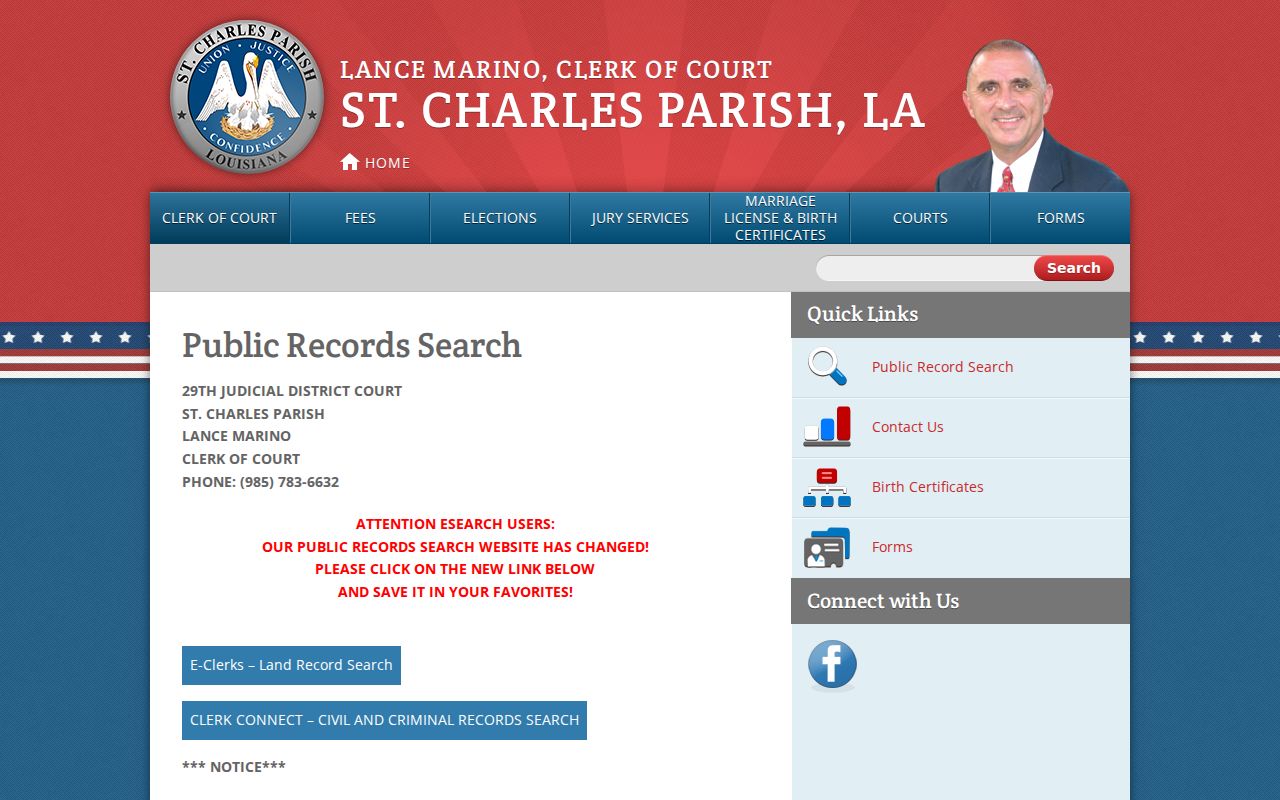
A portal listing is not the final word. Confirm each docket entry or image with the clerk before relying on it.
Finding St. Charles Parish Court Dates
A court date lives inside the case record, not on a calendar alone. Pull the notice, citation, or newest docket event. Also grab the minute entry or signed order. Read it for the current date, time, division, and event type. A date marked continued, reset, vacated, or passed is history. A later entry must supply the new setting.
For district-court divisions, the 29th JDC judge pages are the strongest official channel for contacting a setting. Confirm a JP date with that JP office directly. The Clerk can help locate a record or a clerk-held setting notice at (985) 783-6632. The division's minute clerk may be best placed to confirm a current trial-call order. The judge pages say Zoom attendance requires prior written authorization. Court access continues for approved audiovisual proceedings unless restricted. Never infer attendance arrangements from a docket entry alone.
St. Charles Parish Traffic Docket Volume
Traffic sits on its own docket layer in St. Charles Parish. The Louisiana Supreme Court's 2024 annual-report table lists 13,547 traffic filings for the 29th JDC, against 1,785 civil filings and 669 criminal filings. The same table puts total filings at 16,270. Those are reporting categories. They do not count drivers, unpaid tickets, or people with cases.
Traffic and non-arrest misdemeanors also follow a local annual allotment schedule. It is posted in the Clerk's Office. One citation can name the court. It may tie together the responsible JP and the Sheriff's Bonds and Fines process. Paying a ticket does not, by itself, prove a hearing was canceled. It does not prove the court record closed either.
Note: Annual-report categories do not directly count separate people or unresolved cases.
Public Access to St. Charles Parish Dockets
Louisiana access law guarantees inspection and copying of public court records. It does not put every record image online. The Clerk is the legal custodian of 29th JDC records. The Clerk must allow lawful examination and copying during required office hours, subject to exceptions. Sealed files, juvenile matters, protected victim information, redacted identifiers, and other restricted material call for a separate analysis.
A dismissal does not seal a case automatically. A docket event can be visible even when the document behind it is restricted. If access is denied or a result looks incomplete, ask the Clerk which statute, rule, or court order governs the item. Ask too whether a nonexempt portion can be supplied.
Key rules:
La. C.C.P. art. 251 makes the clerk the custodian and generally allows lawful inspection and copying during required office hours.
La. R.S. 44:31 recognizes a qualifying person’s right to inspect or copy public records unless an exception applies.
La. Ch.C. art. 412 makes juvenile proceeding records confidential except for stated statutory access.
Louisiana Supreme Court Rule V, Section 5 governs documents submitted with a motion to seal and the effect of a ruling.
St. Charles Parish Court Record History
Hahnville's courthouse history explains why an old record may look nothing like a modern portal result. The parish history sets the first courthouse in 1804. A second building came in 1826, an expansion in 1926, and replacement of the historic structure in 1976. The present courthouse lobby keeps that story alive. It holds a scale model of the former building.
LCRAA came much later. Its statewide portal started with participating land-record indices and grew from there. So a St. Charles milestone there says nothing about full historical 29th JDC dockets or images. For an old file, ask the Clerk a question: must a bound docket, archive, microfilm, or off-site case jacket be searched?
Louisiana's Judicial Branch overview places district-court records within the state court system.
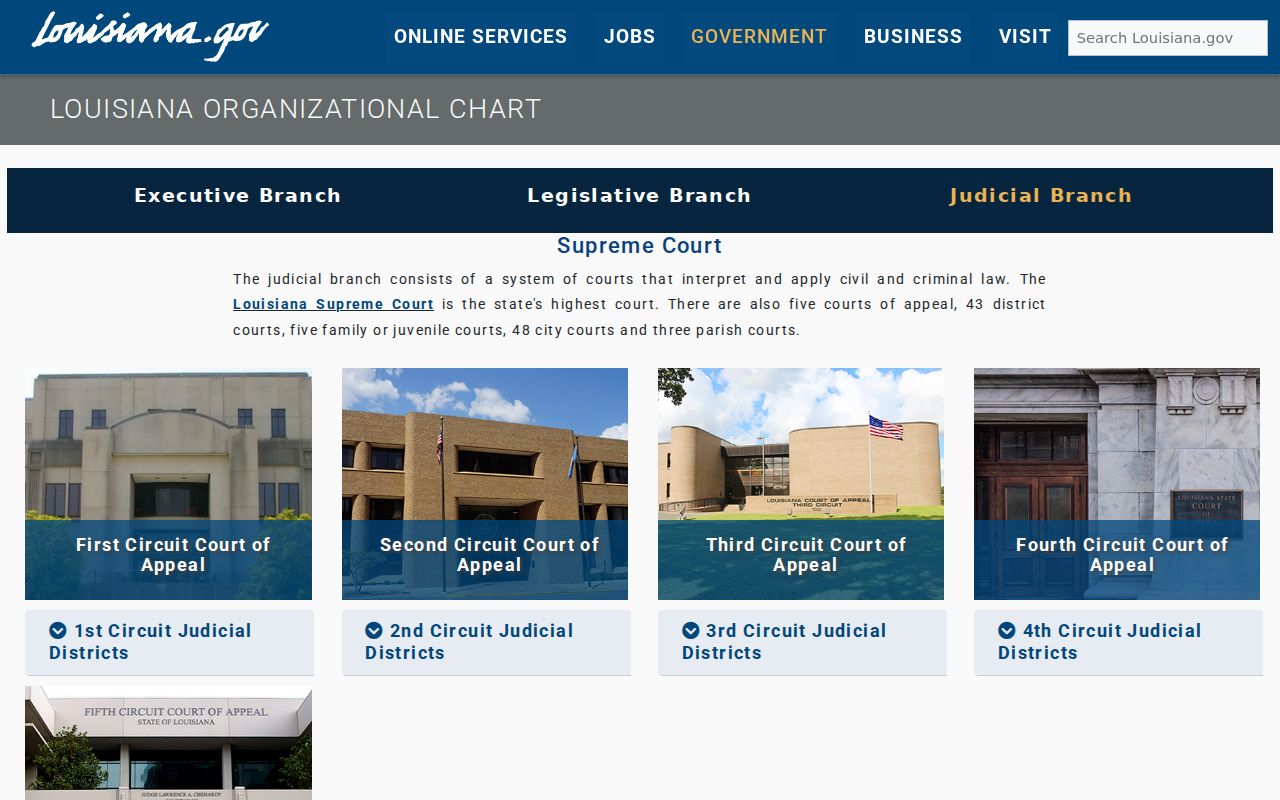
The statewide overview supplies context only. For a specific file, the parish Clerk and the court that created the record remain the sources.
St. Charles Parish Clerk Docket Records
The St. Charles Parish Clerk of Court is the legal custodian for the 29th JDC's civil, criminal, juvenile, family, probate, and related appellate filings. The Clerk can tell apart a docket index, a document image, a minute extract, a plain copy, a conformed copy, and a certified copy. The parish public-records page routes court and vital-record requests to the Clerk. They skip the parish council's general request queue.
Mail a request with key details. Include the case number if known, caption or party roles, division, document title or date, desired copy type, and return contact information. Ask for the current total before sending payment. Fees for electronic images, payment methods, and turnaround times vary. Civil statutory maximums are $1 per page for copies and $5 for certification; confirm the actual charge with the office.
St. Charles Parish Clerk of Court
15045 River Road
Hahnville, LA 70057
(985) 783-6632
Note: Send clerk correspondence to P.O. Box 424, Hahnville, LA 70057.
St. Charles Parish Setting Staff
Need to confirm a 29th JDC setting that is coming up soon? Start with the division handling the case, then work through that division's staff. The Division C, Division D, and Division E pages each list who fills those roles. The roles include judicial assistants, court reporters, criminal and civil minute clerks, and bailiffs. A minute clerk is the right person to ask. They can check whether the case record holds a newer setting notice or order. That call works well when an online St. Charles Parish court docket search is unavailable, confusing, or slow. It is a solid backup.
The judge pages also give the court's central division number. It is (985) 783-2923. Have the case number, division, party name, and the date in question ready. One caution on payments. A payment record does not establish a current court setting. For JP matters, contact the individual JP office. Do not use district-court division staff.
Note: Staff can confirm case administration. They cannot replace a filed order or give legal advice.
St. Charles Parish Juvenile Docket Limits
Juvenile matters never show up as ordinary public docket results. Louisiana Children's Code article 412 keeps records and reports from juvenile proceedings confidential. The rule bends only in stated exceptions. The 29th JDC's Families In Need of Services program is likewise a family-centered diversion and legal process. It is not a public case-search system for individuals. So an empty public result never proves that no juvenile matter exists. That is true throughout St. Charles Parish.
Names, protected personal information, and specialty-program participation raise the same concern. Ask the Clerk where a restriction comes from. It may be the juvenile statute, a sealing rule, a protective order, or some other court order. Only the court or the authorized custodian can describe the permitted route for a restricted record.
St. Charles Parish Appeals Need Another Docket
An appeal builds a second layer of record. Appeals from the 29th JDC go to the Louisiana Fifth Circuit Court of Appeal. A JP case can first create an appellate record at the district court. A St. Charles Parish trial-court docket may show a notice or record of appeal. It is no substitute for the appellate docket itself. The Fifth Circuit's eCourt route covers case, docket, decision, and announcement searches. Its eAccess service is described as fee-based public access to Clerk of Court records.
Federal cases sit in a separate system again. A federal civil or criminal matter tied to the parish belongs to the Eastern District of Louisiana. That court runs on PACER and CM/ECF rather than the Louisiana Fifth Circuit. Save the court name and case number before you search. Then search. State and federal records do not share a docket.
St. Charles Parish Community Docket Routes
St. Charles Parish's largest community profiles help with local routing, but they do not claim each place runs its own municipal court. The official parish profile lists these places as Census Designated Places or unincorporated communities, and no incorporated municipal court appears among them. A community case may still reach several doors. Those doors include the 29th JDC, the relevant JP district, Sheriff Bonds and Fines, or the court named on a citation. Each route below keeps that distinction clear.
Luling Community Docket Route
West Bank route for records held by the court or office named in the case.
Destrehan Community Docket Route
East Bank route, with JP and 29th JDC custody determined by the matter.
St. Rose Community Docket Route
Community route for a citation, JP matter, or district-court record.
Boutte Community Docket Route
West Bank route that does not imply a separate city court.
Norco Community Docket Route
East Bank route for locating the responsible parish, JP, or federal court record.
Map and Directions to the St. Charles Parish Courthouse
29th Judicial District Court civil, criminal, and juvenile records for St. Charles Parish are kept at the courthouse, 15045 River Road in Hahnville, which also houses the Clerk of Court, the District Attorney, and the Sheriff's Office. Public entry is through the front-lobby doors nearest the Sheriff's Tax Office.
St. Charles Parish Clerk of Court
15045 River Road
Hahnville, LA 70057
(985) 783-6632
Monday-Friday, 8:00 a.m.-4:30 p.m., excluding holidays
All patrons pass through a metal detector and X-ray baggage screening at the lobby entrance; firearms, illegal narcotics, knives, scissors, box cutters, letter openers, and other edged weapons are barred unless a legitimate courthouse need is established. Parking, public-terminal, and Wi-Fi details are not published, so call the Clerk before a visit that depends on them.